



 English
 بالعربية
 Deutsch
 Français
 Bahasa Indonesia
 Italiano
 日本語
 қазақ
 한국어
 Bahasa Malay
 Монгол
 Nederlands
 Język polski
 Português
 Русский язык
 Español
 ภาษาไทย
 Türkçe
채광, 채석 및 골재 생산에서 콘 크러셔는 지속적인 충격, 압축 및 마모 조건에서 작동합니다. 내부 마모 부품의 성능은 장비 신뢰성, 파쇄 효율성 및 유지 관리 비용에 직접적인 영향을 미칩니다. 이들 구성요소 중에서,콘 크러셔 맨틀그리고그릇 라이너주요 마모 표면입니다. 함께 작동하여 파쇄실을 형성하고 반복적인 압축을 통해 암석과 광석을 감소시킵니다.
작동 중 광석 경도, 공급량, 분쇄 부하 및 장비 설정은 모두 콘 크러셔 라이너 마모에 영향을 미칩니다. 부적절한 재료 선택, 잘못된 라이너 프로파일 또는 고르지 않은 마모로 인해 빈번한 교체, 계획되지 않은 가동 중지 시간 및 제품 크기 변경이 발생할 수 있습니다.
다양한 채광 및 골재 응용 분야를 충족하기 위해 Haitian Casting은 Mn13Cr2, Mn18Cr2 및 Mn22Cr2와 같은 고망간강 등급을 사용하여 콘 크러셔 라이너를 제조합니다. 재료 선택은 제어된 주조, 수질 강화 열처리 및 품질 검사와 결합되어 다양한 분쇄기 모델 및 작동 조건에 맞는 마모 부품을 생산합니다.
1. 콘 크러셔 라이너의 주요 유형은 무엇입니까?
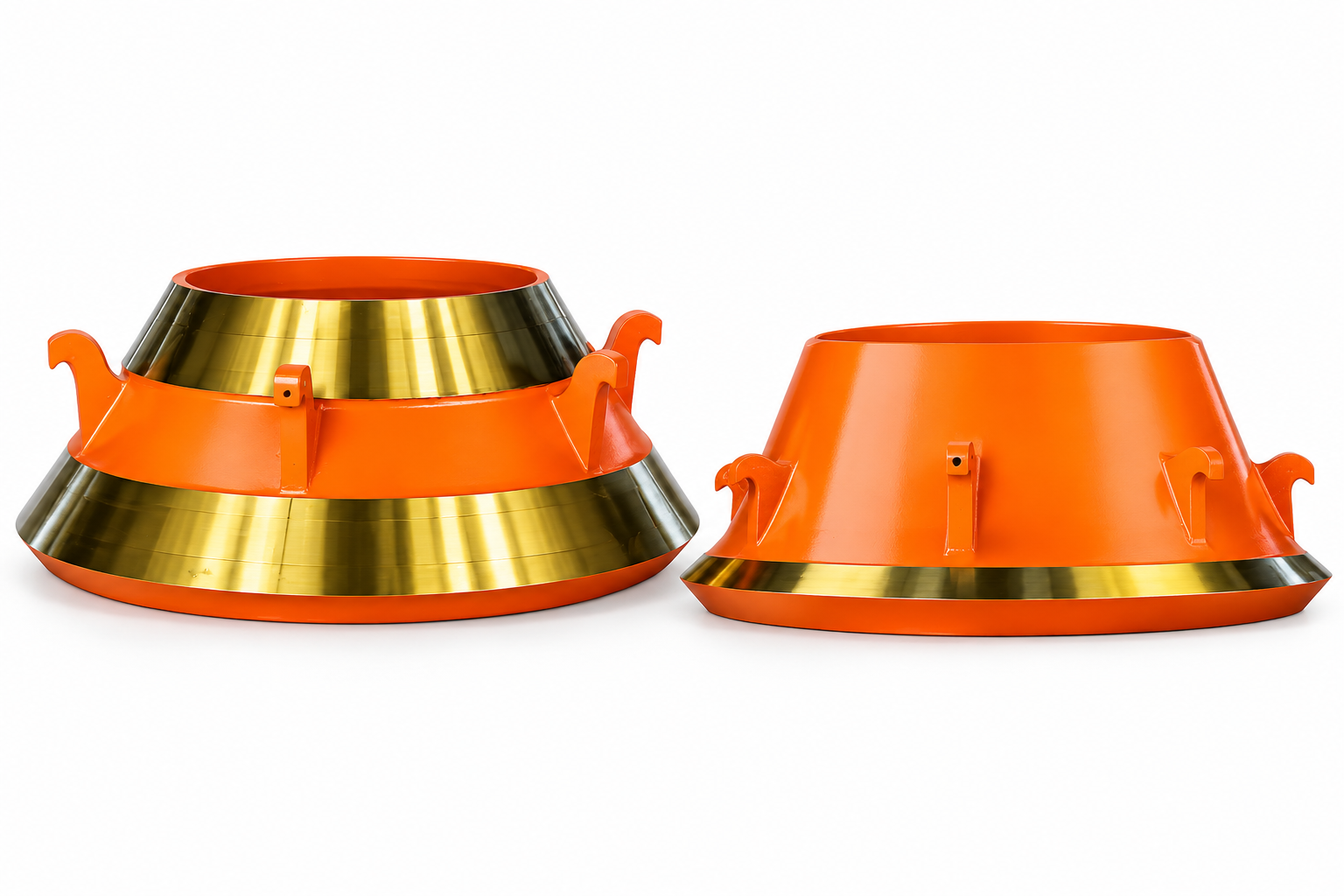
주요 콘 크러셔 라이너는 맨틀과 오목형이라고도 알려진 보울 라이너입니다. 이러한 구성 요소는 분쇄실의 작업 표면을 형성하며 반복적인 충격, 압축 및 마모에 직접 노출됩니다.
1. 콘 크러셔 맨틀
맨틀은 분쇄기 헤드에 장착되어 움직이는 내부 라이너입니다. 작동 중에 헤드의 편심 움직임으로 인해 맨틀이 고정된 보울 라이너에 접근하여 멀어지게 됩니다. 파쇄실로 들어가는 암석은 이 두 표면 사이에서 압축됩니다.
맨틀은 파쇄하중과 마모성 물질에 지속적으로 노출되기 때문에 적절한 충격인성과 내마모성이 요구됩니다. 그 프로필과 두께 분포는 분쇄실의 기하학적 구조와 작동 중 마모 패턴에도 영향을 미칩니다.
2. 콘 크러셔 보울 라이너
오목형이라고도 불리는 보울 라이너는 분쇄기 상부에 설치되는 고정형 외부 라이너입니다. 맨틀과 함께 작용하여 분쇄실을 형성합니다.
보울 라이너는 공급 물질의 지속적인 충격과 압축에 노출됩니다. 작업 표면은 작동 중에 점차적으로 마모되며, 프로필의 변화는 분쇄실 형상과 분쇄기 작동 조건에 영향을 미칠 수 있습니다.
이 구성요소에 대한 자세한 내용은 다음을 참조하세요.콘 크러셔 보울 라이너제품 페이지.
3. 맨틀과 보울 라이너의 일치가 중요한 이유
맨틀과 보울 라이너는 분쇄기 모델과 챔버 설계에 따라 일치하는 세트로 선택해야 합니다. 프로파일, 치수 및 설치 위치가 함께 작용하여 사용 가능한 분쇄 공간을 결정합니다.
한 라이너가 다른 라이너보다 훨씬 빠르게 마모되면 원래 챔버 프로필이 변경될 수 있습니다. 이는 자재 흐름, 제품 크기 및 분쇄 하중 분포에 영향을 미칠 수 있습니다. 따라서 라이너 선택 및 교체는 각 구성 요소를 개별적으로 평가하기보다는 완전한 파쇄실을 고려해야 합니다.
2. 일반적인 마모 문제와 그 원인
콘 크러셔 라이너는 까다로운 조건에서 작동합니다. 마모율과 마모 패턴은 광석 특성, 공급 조건, 분쇄기 설정 및 재료 성능의 영향을 받습니다.
1. 경질 및 연마성 공급 재료
단단한 연마성 광물을 함유한 광석, 특히 실리카 함량이 높은 재료는 라이너 표면의 마모를 가속화할 수 있습니다. 광산마다 경도, 광물 구성, 입자 크기 분포가 다른 재료를 처리합니다. 결과적으로 동일한 라이너 디자인이라도 현장마다 서비스 성능이 다를 수 있습니다.
2. 높은 충격 하중 및 국부적인 마모
큰 공급 입자와 집중된 충격 하중은 분쇄실의 특정 영역에서 고르지 않은 마모를 일으킬 수 있습니다. 이러한 조건에서 라이너 소재가 충분한 인성을 제공하지 않으면 균열이나 국부적인 손상이 발생할 위험이 높아질 수 있습니다.
3. 고르지 못한 사료분배
재료가 분쇄실 주위에 고르게 분포되지 않으면 맨틀 또는 보울 라이너의 한 부분이 다른 부분보다 더 높은 하중을 받을 수 있습니다. 시간이 지남에 따라 마모가 고르지 않게 되고 원래 챔버 프로필이 변경될 수 있습니다.
4. 부적합한 라이너 재료
라이너 성능은 경도만으로 결정되지 않습니다. 충격이 심한 용도에는 충분한 인성이 필요하고, 마모성이 높은 용도에는 적절한 내마모성과 가공 경화 특성이 필요합니다.
Selecting a material without considering the actual operating conditions may result in premature wear or unexpected component damage.
5. Incorrect Liner Profile or Installation
Different cone crusher models and chamber configurations require specific liner profiles and dimensions. If the liner geometry or installation fit does not meet equipment requirements, localized loading, uneven wear, or installation problems may occur.
3. How Does Material Selection Improve Cone Crusher Liner Wear Resistance?
Material selection is one of the key factors affecting cone crusher liner performance. High-manganese steel is widely used in crushing equipment because of its ability to work-harden under impact while maintaining good toughness.
Haitian Casting offers different high-manganese steel grades according to equipment specifications and operating conditions.
1. Mn13Cr2 High-Manganese Steel
Mn13Cr2 is suitable for crushing applications involving moderate impact loads. Under repeated impact and compression, its surface can gradually work-harden while the interior maintains toughness. It is an option for cone crusher liners operating under suitable crushing conditions.
2. Mn18Cr2 High-Manganese Steel
Mn18Cr2 offers a combination of impact toughness and work-hardening characteristics. It can be considered for applications involving moderate to relatively high impact loads, depending on ore properties and crusher operating conditions.
3. Mn22Cr2 High-Manganese Steel
Mn22Cr2 is another high-manganese steel option for selected demanding crushing applications. Its suitability should be evaluated according to feed characteristics, impact conditions, liner design, and heat-treatment quality.
Material Selection Should Consider More Than Hardness
The actual wear performance of high-manganese steel liners depends on several factors, including chemical composition, heat treatment, casting quality, liner geometry, and operating conditions.
For high-impact applications, toughness and resistance to cracking are important considerations. For highly abrasive materials, work-hardening behavior and actual wear performance should also be evaluated.
The appropriate material should therefore be selected based on equipment specifications and operating conditions rather than simply choosing the material with the highest initial hardness.
4. How Does Liner Design Affect Service Life?
In addition to material properties, liner design has an important influence on crushing chamber performance and wear distribution.
1. Proper Crushing Chamber Profile
The working profiles of the mantle and bowl liner determine the geometry of the crushing chamber. Different chamber designs are intended for different feed sizes, crushing stages, and product requirements. The liner profile must be compatible with the crusher model and application.
2. Optimized Thickness Distribution
Different areas of a cone crusher liner may experience different levels of impact and abrasion. Adjusting the thickness of specific areas according to the design requirements and observed wear patterns can help provide appropriate wear allowance.
3. Accurate Installation Dimensions
Cone crusher liners must fit the corresponding equipment surfaces and mounting structures. Critical dimensions, contact areas, and working profiles should meet the technical requirements to avoid installation difficulties or abnormal loading.
4. Matching the Mantle and Bowl Liner
The mantle and bowl liner should be considered as a complete crushing chamber system. Their profiles and dimensions need to work together to maintain the intended crushing space and discharge conditions.
5. When Should Cone Crusher Liners Be Replaced?
There is no single replacement interval that applies to every cone crusher. Actual liner service life depends on ore hardness, abrasiveness, feed size, production load, crusher settings, and material selection.
During routine maintenance, operators should pay attention to the following conditions:
Insufficient remaining liner thickness: Check whether the liner has approached the replacement limit specified for the equipment.
Uneven wear patterns: Excessive localized wear may indicate uneven feed distribution, unsuitable operating conditions, or a mismatch between liner design and application.
Cracks or visible damage: Inspect the liner and related installation structures if cracks or other damage are found.
Changes in product size: If feed conditions and crusher settings remain stable but the output particle size changes, liner wear and the discharge setting should be checked.
Abnormal equipment operation: Unusual vibration, noise, or changes in production capacity should be investigated together with equipment parameters and liner condition.
Before installing replacement liners, inspect the mounting surfaces, fastening structures, and related components. Replacement should follow the equipment manufacturer's installation and safety procedures.
6. Cone Crusher Liner Manufacturing and Quality Control at Haitian Casting
Cone crusher liners are large wear-resistant castings. Their quality depends not only on material composition but also on melting, casting, heat treatment, dimensional control, and final inspection.
Haitian Casting has extensive experience in the development and production of wear-resistant castings for mining and aggregate equipment. Our manufacturing processes focus on the requirements of cone crusher mantles and bowl liners.
1. Raw Material Selection
Scrap steel and alloying materials are selected and controlled according to production requirements. Attention is given to raw material cleanliness and chemical composition to support consistent high-manganese steel quality.
2. Controlled Melting and Chemical Composition
Electric furnace melting is used for material production. A spectrometer is applied to analyze and verify the molten metal composition, with particular attention to carbon, manganese, chromium, and other key elements.
3. Optimized Casting Process
Molding, pouring, and feeding systems are designed according to the liner's structure, wall thickness, and weight. The casting process is controlled to reduce the risk of shrinkage porosity, shrinkage cavities, and other casting defects.
4. Water-Toughening Heat Treatment
High-manganese steel liners undergo water-toughening heat treatment to obtain a suitable austenitic structure. This process helps provide the toughness and work-hardening characteristics required for demanding crushing applications. The treatment parameters are controlled according to material composition, casting dimensions, and product specifications.
5. Dimensional and Surface Inspection
Critical dimensions, working profiles, mounting areas, and casting surfaces are inspected to ensure that the finished liners meet approved drawings and customer requirements.
6. Non-Destructive Testing and Quality Inspection
Hardness testing and appropriate non-destructive testing are carried out according to product specifications. Inspection methods are selected to evaluate surface or internal defects as required. Quality records and inspection reports can be provided according to order requirements.
7. Why Choose Haitian Casting for Cone Crusher Liners?
Haitian Casting specializes in wear-resistant castings for mining, construction materials, and industrial applications. With experience in high-manganese steel production, we provide customized cone crusher mantles and bowl liners according to equipment models and operating requirements.
Multiple Material Options
Mn13Cr2, Mn18Cr2, and Mn22Cr2 high-manganese steel options are available for different crushing conditions. Material selection considers ore properties, impact loads, and abrasiveness.
Customized Production Based on Drawings
We support customized production according to equipment brands, models, technical drawings, or physical samples. Attention is given to liner dimensions, working profiles, and installation requirements.
Established Manufacturing Processes
From raw material control and melting to casting, water-toughening heat treatment, and final inspection, each production stage follows corresponding quality control procedures.
Production Tracking and Quality Records
Our production management system supports order progress tracking. Quality inspection records are maintained according to order requirements, providing customers with production and quality information. Our team also responds to product quality concerns and works with customers to review and address specific issues.
Explore our 콘 크러셔 마모 부품 to learn more about Haitian's range of crusher components.
8. Frequently Asked Questions About Cone Crusher Liners
Q1: What are the main types of cone crusher liners?
The two main types are the mantle and the bowl liner, also known as the concave. They form the crushing chamber and withstand the impact, compression, and abrasion generated during rock crushing.
Q2: What materials are commonly used for cone crusher liners?
Common materials include Mn13Cr2, Mn18Cr2, and Mn22Cr2 high-manganese steel. The appropriate grade depends on ore hardness, impact conditions, abrasiveness, and crusher operating requirements.
Q3: Which is more wear-resistant, Mn18Cr2 or Mn22Cr2?
The wear performance of these materials cannot be determined by manganese content alone. Chemical composition, heat treatment, work-hardening conditions, and ore characteristics all influence actual performance. Material selection should be based on the specific application.
Q4: Why do cone crusher liners wear unevenly?
Uneven wear may be related to feed distribution, particle-size differences, crushing chamber geometry, operating parameters, or liner installation. Reviewing the actual wear profile and equipment operating data can help identify the cause.
Q5: Does Haitian Casting manufacture customized mantles and bowl liners?
Yes. Customers can provide the crusher brand, model, original drawings, or physical samples. Our team reviews the dimensions, structure, and material requirements before production.
Q6: What is the delivery time for cone crusher liners?
Delivery time depends on product dimensions, weight, structural complexity, tooling requirements, and the production schedule. The estimated lead time can be confirmed after the drawings and technical specifications have been reviewed.
Q7: How can the replacement frequency of cone crusher liners be reduced?
Start by selecting a suitable liner material and chamber profile for the ore being processed. Maintain appropriate feed distribution and crusher operating parameters, and inspect liner wear regularly. Identifying uneven wear and abnormal operating conditions early can help improve effective liner utilization.
결론
The wear resistance of cone crusher liners is closely related to material composition, heat-treatment quality, structural design, and actual operating conditions. Selecting suitable mantles and bowl liners helps manage wear, maintain the intended crushing chamber profile, and support stable equipment operation.
Haitian Casting manufactures high-manganese steel cone crusher liners using materials such as Mn13Cr2, Mn18Cr2, and Mn22Cr2. Customized mantles and bowl liners are available according to equipment models, technical drawings, and crushing applications.
Contact Haitian Casting to discuss your cone crusher mantle, bowl liner, and other mining wear part requirements.

 틱톡


