


 English
 بالعربية
 Deutsch
 Français
 Bahasa Indonesia
 Italiano
 日本語
日本語 қазақ
қазақ 한국어
한국어 Bahasa Malay
 Монгол
 Nederlands
 Język polski
 Português
 Русский язык
 Español
 ภาษาไทย
 Türkçe
In concrete mixing equipment, construction machinery, and building material production equipment, Mixing Arms and Arm Protection are critical wear parts that are continuously exposed to impact and abrasion. Because equipment structures vary between brands and models, overseas customers often require customized wear-resistant castings based on actual equipment dimensions, installation requirements, and operating conditions when upgrading equipment, replacing spare parts, or developing new projects.
For new product development, the real challenge is not simply producing the parts. It is completing the entire process—from drawing confirmation and structural design to casting process development, mold production, material selection, heat treatment, and final inspection—in a short period while ensuring that the new products are ready for field testing and subsequent mass production.
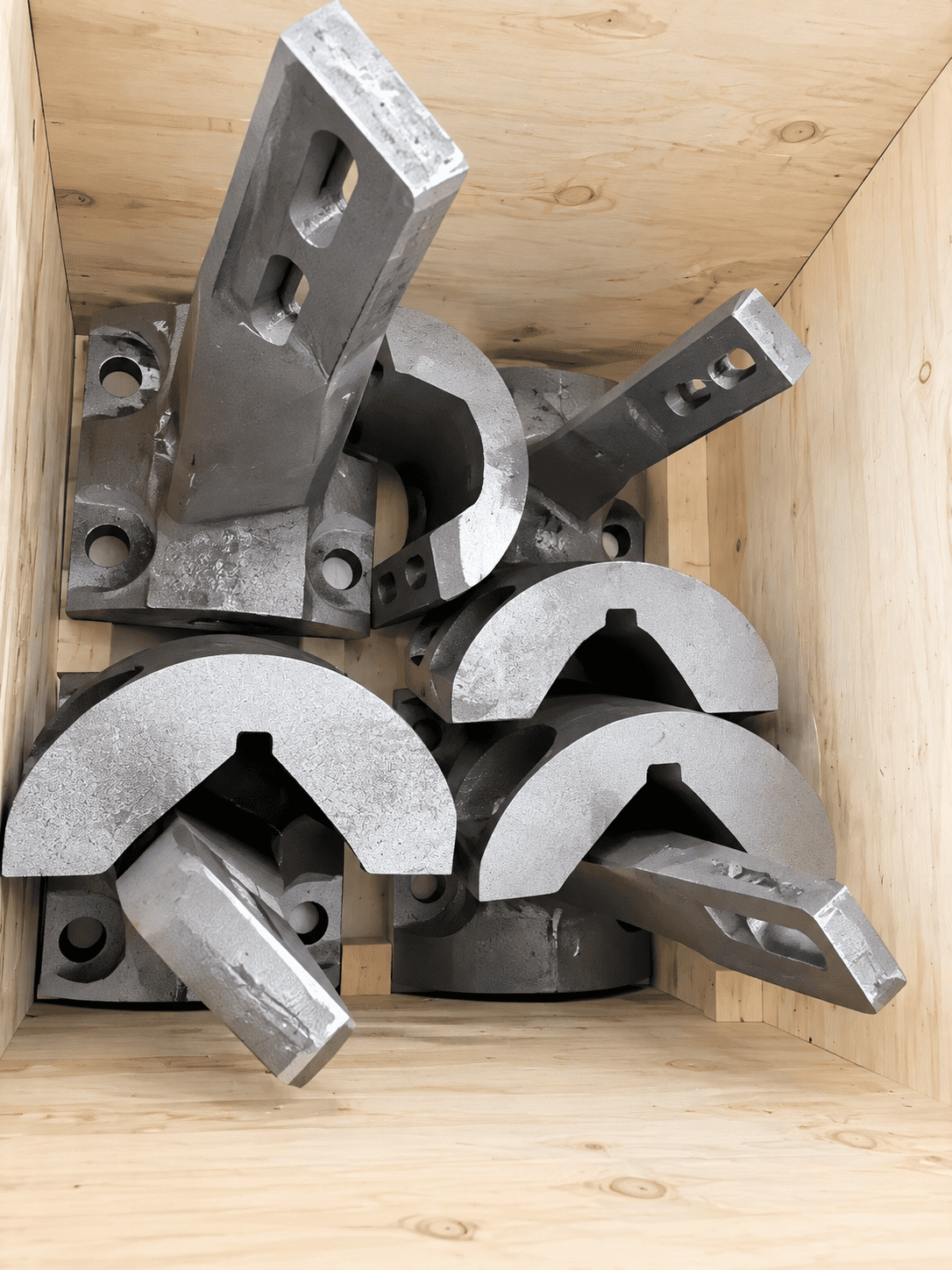
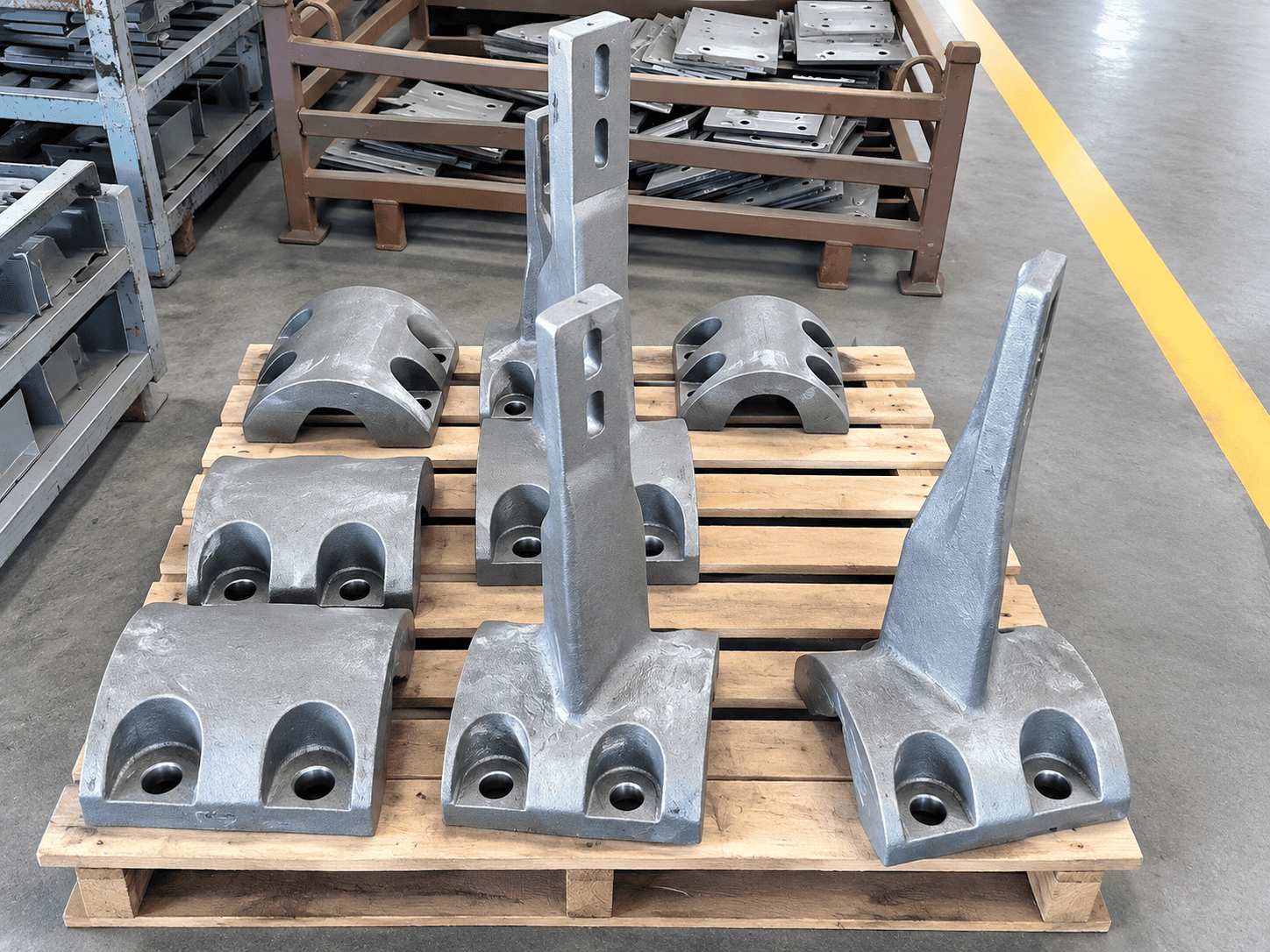
Haitian Casting relies on a professional technical R&D team, 3D sand printing technology, wear-resistant material development capabilities, and a complete casting production system to provide a rapid development process for customized Concrete Mixing Plant Parts. Recently, Haitian completed the development of 8 new products for an overseas customer, including Mixing Arms and Arm Covers, with production and delivery completed within 20 days.
This project demonstrates not only the rapid prototyping capability of 3D printing, but also Haitian's overall technical capability covering product design, casting process development, manufacturing, and quality inspection.
8 New Products Developed Together and Delivered Within 20 Days
The customer project involved 8 different types of new wear parts, mainly including Mixing Arms and Arm Covers. Since these were customized products, each design required dimensional confirmation and a dedicated manufacturing process based on the customer's actual equipment structure.
Key project data:
Number of new products: 8
Product types: Mixing Arms and Arm Covers
Development and production cycle: 20 days
Manufacturing method: 3D sand printing + casting
After receiving the customer's drawings and technical information, Haitian's technical team analyzed the product structures and developed digital models and casting processes according to manufacturing requirements. After model confirmation, 3D sand printing was used to rapidly produce the molds, followed by melting, pouring, casting cleaning, heat treatment, and quality inspection.
For overseas customers developing multiple new products simultaneously, completing the production and delivery of 8 products within 20 days can significantly shorten the product validation cycle and allow the parts to enter field installation and testing sooner.
Professional Technical Team: From Product Structure to Casting Process Development
3D printing can shorten mold preparation time, but the success of a new product still depends on the technical team's ability to control product structure and casting processes.
Haitian Casting has a professional technical R&D team. During new product development, the team does not simply manufacture products according to customer drawings. Instead, it conducts a comprehensive analysis of product structure, operating conditions, wear areas, installation dimensions, and casting manufacturability.
For a Concrete Mixing Plant Mixing Arm, particular attention is paid to wear areas, load-bearing structures, and installation compatibility with the mixing shaft and other components. For an Arm Protection, installation dimensions, connection structures, and overall product strength are key considerations.
Based on the product structure, the technical team develops the corresponding casting process, analyzing and optimizing the mold cavity, gating system, riser design, and critical areas to reduce the risk of casting defects such as shrinkage cavities, shrinkage porosity, gas porosity, and incomplete filling.
Therefore, 3D printing is only one part of rapid new product development. The technical team's process design and manufacturing experience are equally important to the final product quality.
3D Sand Printing Technology: From Digital Models to Physical Products
Traditional development of new wear castings usually involves mold design, mold manufacturing, trial production, and process adjustments. When several different products need to be developed at the same time, the preparation period can become even longer.
Haitian uses 3D sand printing technology to rapidly produce sand molds based on confirmed digital models, reducing the preparation time normally required for traditional wooden or metal patterns.
For complex or customized Concrete Mixer Wear Parts, such as Mixing Arms and Arm Covers, 3D sand printing provides a more flexible approach to new product development, particularly for multi-model development, small-batch production, and customized wear parts.
The basic process is:
Customer drawings/samples → Digital modeling → Casting process design → 3D sand printing → Melting and pouring → Casting cleaning → Heat treatment → Machining → Quality inspection → Delivery
By combining digital design with 3D printing, Haitian can shorten the early development cycle while providing greater flexibility for subsequent structural optimization and product development.
Wear-Resistant Materials for Mixing Arms and Arm Covers
As important Concrete Mixer Wear Parts, Mixing Arms and Arm Covers are continuously exposed to impact and friction from aggregates, sand, and concrete materials. Their service life is therefore closely related to the wear-resistant material system.
Haitian Casting has wear-resistant material development and formulation adjustment capabilities. Based on product structure and actual operating conditions, the appropriate material system can be selected for different applications.
Material development focuses on a combination of wear resistance, hardness, impact toughness, and operating conditions. Simply increasing hardness does not necessarily result in better overall performance. Under high-impact conditions, sufficient toughness is also required to reduce the risk of cracking and breakage.
The technical team matches the material system with the manufacturing process according to the customer's equipment information and product requirements, helping ensure that material properties are better suited to the product structure and actual working environment.
Casting and Heat Treatment Technology for Stable Product Performance
After 3D sand printing, the products still need to go through a complete casting production process before delivery.
Haitian Casting controls key production parameters such as melting temperature, chemical composition, pouring conditions, and cooling processes to maintain stable internal structure and overall casting quality.
After casting, the products undergo cleaning and heat treatment. Appropriate heat treatment is used to adjust the material's internal structure and achieve a more stable combination of hardness and toughness.
For wear-resistant Mixing Arms and Arm Covers, a reasonable balance between wear resistance and impact resistance is essential. Therefore, material development, casting processes, and heat treatment are not independent steps, but are matched and optimized as an integrated process by the technical team.
Full-Process Quality Inspection from Raw Materials to Finished Products
Quality inspection is particularly important during new product development. The first batch of products must not only meet the drawing dimensions, but also verify material properties, casting quality, and overall structural requirements.
Haitian has established a full-process quality control and inspection system, covering production from incoming raw materials through to final products.
Depending on customer requirements, the main inspection procedures include:
Chemical Composition Testing: Spectral analysis is used to verify whether the material composition meets technical requirements.
Dimensional Inspection: Overall dimensions, critical installation dimensions, and connection positions are inspected to ensure compatibility with the customer's equipment.
Hardness Testing: Product hardness is tested to verify the material and heat treatment results.
Metallographic Analysis: The internal microstructure is examined to evaluate material properties and heat treatment quality.
Visual Inspection: Product surfaces are checked for visible defects such as cracks, porosity, and inclusions.
Final Inspection: Final dimensions, appearance, and relevant performance requirements are confirmed before packaging and delivery.
Through multi-stage quality control, Haitian ensures that new products are not only dimensionally correct but also meet requirements for material properties and internal casting quality.
Manufacturing Capability Is the Foundation of Fast Delivery
Completing a new product project within 20 days is not the result of a single machine or technology. It comes from the combined capabilities of technical R&D, production equipment, material systems, and quality management.
Haitian Casting has a complete wear casting manufacturing system that connects new product design, 3D sand printing, material development, casting, heat treatment, machining, and quality inspection.
The technical team is responsible for product structure and process development, the production team manages manufacturing execution, and the quality team performs inspections throughout the process. Close coordination between these departments helps improve both development and production efficiency.
This integrated manufacturing capability also allows Haitian to move quickly from new product validation to subsequent mass production without requiring customers to work with different suppliers for different manufacturing stages.
From 8 New Products to Future Mass Production
For overseas customers, the ultimate purpose of new product development is not simply to obtain several samples. The products need to pass field testing and eventually become part of a stable supply program.
After new product development, Haitian can continue to optimize product structure, material formulations, and casting processes based on customer feedback from actual applications, and then proceed with mass production using the final approved product data.
For Mixing Arms, Arm Covers, Concrete Mixer Wear Parts, and other customized wear castings, customers can provide drawings, physical samples, dimensional data, or equipment models for the technical team to analyze and develop.
From digital modeling and 3D sand printing to casting, heat treatment, and final inspection, the entire process is carried out according to the customer's product requirements.
Haitian Casting: Rapid New Product Development and Wear Casting Manufacturing
With 8 new products completed and delivered within 20 days as the core result, this project demonstrates Haitian Casting's overall capability in rapid development of customized wear parts.
Supported by a professional technical R&D team, 3D sand printing technology, wear-resistant material development capabilities, professional casting equipment, heat treatment processes, and a full-process quality inspection system, Haitian provides overseas customers with integrated services from new product development through mass production.
For customers looking to develop Concrete Mixer Mixing Arms, Arm Covers, and Concrete Mixer Wear Parts, Haitian can provide technical analysis, process development, and manufacturing based on product drawings, samples, and actual operating conditions.
8 new products. 20 days to delivery.
It is not simply about fast production. It reflects the complete factory capability covering technical development, digital manufacturing, casting production, and final quality inspection.

 Tik Tok


