



 English
 بالعربية
 Deutsch
 Français
 Bahasa Indonesia
 Italiano
 日本語
 қазақ
 한국어
 Bahasa Malay
 Монгол
 Nederlands
 Język polski
 Português
 Русский язык
 Español
 ภาษาไทย
 Türkçe
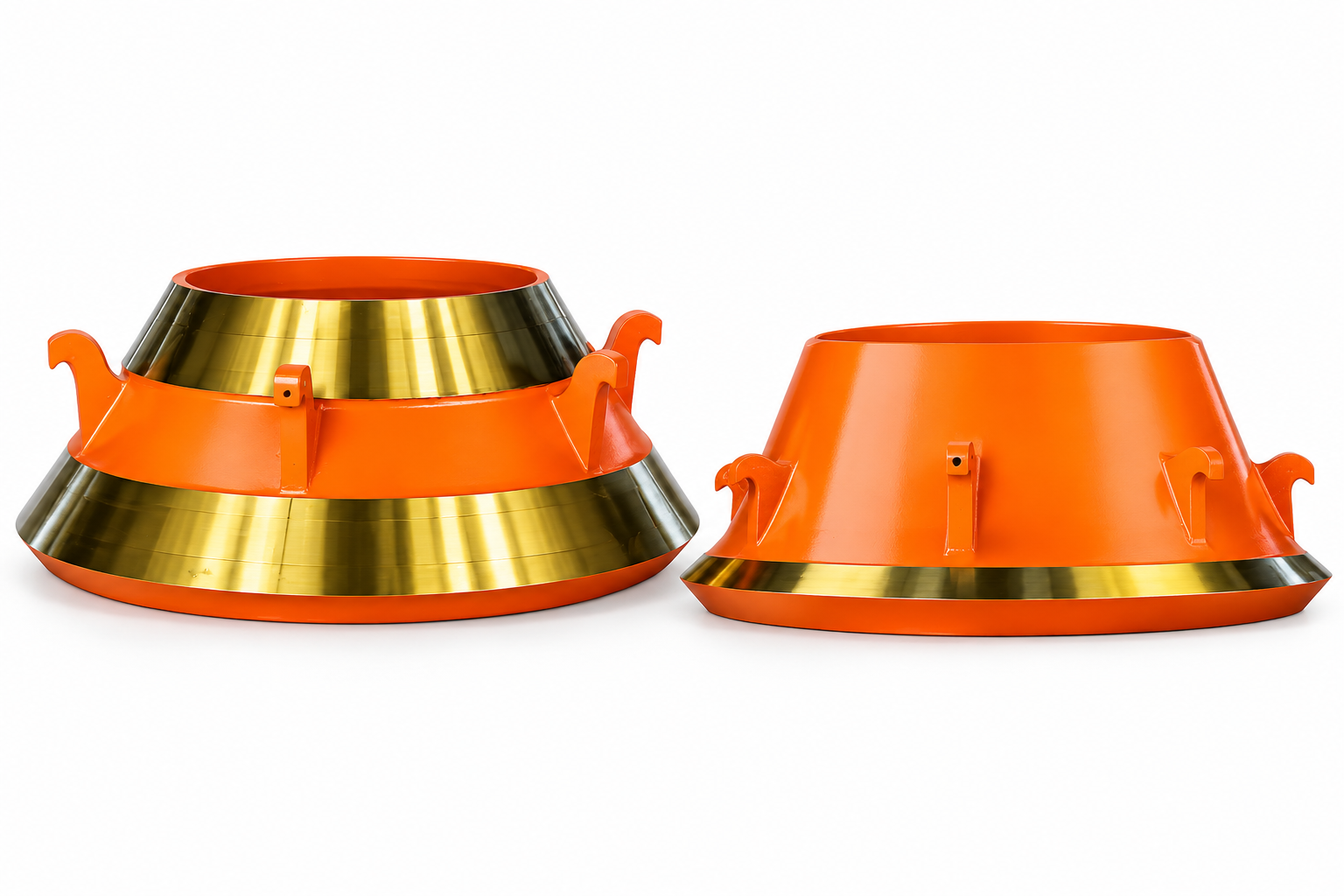
In mining, quarrying, and aggregate production, cone crushers operate under continuous impact, compression, and abrasive conditions. The performance of their internal wear parts directly affects equipment reliability, crushing efficiency, and maintenance costs. Among these components, the cone crusher mantle and bowl liner are the main wear surfaces. Working together, they form the crushing chamber and reduce rock and ore through repeated compression.
During operation, ore hardness, feed size, crushing load, and equipment settings all influence cone crusher liner wear. Unsuitable material selection, incorrect liner profiles, or uneven wear can lead to frequent replacements, unplanned downtime, and changes in product size.
To meet different mining and aggregate applications, Haitian Casting manufactures cone crusher liners using high-manganese steel grades such as Mn13Cr2, Mn18Cr2, and Mn22Cr2. Material selection is combined with controlled casting, water-toughening heat treatment, and quality inspection to produce wear parts for different crusher models and operating conditions.
1. What Are the Main Types of Cone Crusher Liners?
The main cone crusher liners are the mantle and the bowl liner, also known as the concave. These components form the working surfaces of the crushing chamber and are directly exposed to repeated impact, compression, and abrasion.
1. Cone Crusher Mantle
The mantle is the moving inner liner mounted on the crusher head. During operation, the eccentric movement of the head causes the mantle to approach and move away from the stationary bowl liner. Rock entering the crushing chamber is compressed between these two surfaces.
Because the mantle is continuously exposed to crushing loads and abrasive materials, it requires suitable impact toughness and wear resistance. Its profile and thickness distribution also influence the geometry of the crushing chamber and the wear pattern during operation.
2. Cone Crusher Bowl Liner
The bowl liner, also called the concave, is the stationary outer liner installed in the upper part of the crusher. It works together with the mantle to form the crushing chamber.
The bowl liner is exposed to continuous impact and compression from the feed material. Its working surface gradually wears during operation, and changes in its profile can affect the crushing chamber geometry and the crusher's operating condition.
For more information about this component, see our Cone Crusher Bowl Liner product page.
3. Why Mantle and Bowl Liner Matching Matters
The mantle and bowl liner should be selected as a matched set according to the crusher model and chamber design. Their profiles, dimensions, and installation positions work together to determine the available crushing space.
If one liner wears significantly faster than the other, the original chamber profile may change. This can affect material flow, product size, and the distribution of crushing loads. Therefore, liner selection and replacement should consider the complete crushing chamber rather than evaluating each component separately.
2. Common Wear Problems and Their Causes
Cone crusher liners operate under demanding conditions. Their wear rate and wear pattern are influenced by ore properties, feed conditions, crusher settings, and material performance.
1. Hard and Abrasive Feed Materials
Ores containing hard abrasive minerals, particularly materials with high silica content, can accelerate wear on the liner surfaces. Different mines process materials with different hardness, mineral composition, and particle-size distributions. As a result, the same liner design may have different service performance at different sites.
2. High Impact Loads and Localized Wear
Large feed particles and concentrated impact loads can cause uneven wear in certain areas of the crushing chamber. If the liner material does not provide sufficient toughness under these conditions, the risk of cracking or localized damage may increase.
3. Uneven Feed Distribution
When material is not distributed evenly around the crushing chamber, one section of the mantle or bowl liner may experience a higher load than other areas. Over time, this can result in uneven wear and changes to the original chamber profile.
4. Unsuitable Liner Material
Liner performance is not determined by hardness alone. High-impact applications require sufficient toughness, while highly abrasive applications require appropriate wear resistance and work-hardening characteristics.
Selecting a material without considering the actual operating conditions may result in premature wear or unexpected component damage.
5. Incorrect Liner Profile or Installation
Different cone crusher models and chamber configurations require specific liner profiles and dimensions. If the liner geometry or installation fit does not meet equipment requirements, localized loading, uneven wear, or installation problems may occur.
3. How Does Material Selection Improve Cone Crusher Liner Wear Resistance?
Material selection is one of the key factors affecting cone crusher liner performance. High-manganese steel is widely used in crushing equipment because of its ability to work-harden under impact while maintaining good toughness.
Haitian Casting offers different high-manganese steel grades according to equipment specifications and operating conditions.
1. Mn13Cr2 High-Manganese Steel
Mn13Cr2 is suitable for crushing applications involving moderate impact loads. Under repeated impact and compression, its surface can gradually work-harden while the interior maintains toughness. It is an option for cone crusher liners operating under suitable crushing conditions.
2. Mn18Cr2 High-Manganese Steel
Mn18Cr2 offers a combination of impact toughness and work-hardening characteristics. It can be considered for applications involving moderate to relatively high impact loads, depending on ore properties and crusher operating conditions.
3. Mn22Cr2 High-Manganese Steel
Mn22Cr2 is another high-manganese steel option for selected demanding crushing applications. Its suitability should be evaluated according to feed characteristics, impact conditions, liner design, and heat-treatment quality.
Material Selection Should Consider More Than Hardness
The actual wear performance of high-manganese steel liners depends on several factors, including chemical composition, heat treatment, casting quality, liner geometry, and operating conditions.
For high-impact applications, toughness and resistance to cracking are important considerations. For highly abrasive materials, work-hardening behavior and actual wear performance should also be evaluated.
The appropriate material should therefore be selected based on equipment specifications and operating conditions rather than simply choosing the material with the highest initial hardness.
4. How Does Liner Design Affect Service Life?
In addition to material properties, liner design has an important influence on crushing chamber performance and wear distribution.
1. Proper Crushing Chamber Profile
The working profiles of the mantle and bowl liner determine the geometry of the crushing chamber. Different chamber designs are intended for different feed sizes, crushing stages, and product requirements. The liner profile must be compatible with the crusher model and application.
2. Optimized Thickness Distribution
Different areas of a cone crusher liner may experience different levels of impact and abrasion. Adjusting the thickness of specific areas according to the design requirements and observed wear patterns can help provide appropriate wear allowance.
3. Accurate Installation Dimensions
Cone crusher liners must fit the corresponding equipment surfaces and mounting structures. Critical dimensions, contact areas, and working profiles should meet the technical requirements to avoid installation difficulties or abnormal loading.
4. Matching the Mantle and Bowl Liner
The mantle and bowl liner should be considered as a complete crushing chamber system. Their profiles and dimensions need to work together to maintain the intended crushing space and discharge conditions.
5. When Should Cone Crusher Liners Be Replaced?
There is no single replacement interval that applies to every cone crusher. Actual liner service life depends on ore hardness, abrasiveness, feed size, production load, crusher settings, and material selection.
During routine maintenance, operators should pay attention to the following conditions:
Insufficient remaining liner thickness: Check whether the liner has approached the replacement limit specified for the equipment.
Uneven wear patterns: Excessive localized wear may indicate uneven feed distribution, unsuitable operating conditions, or a mismatch between liner design and application.
Cracks or visible damage: Inspect the liner and related installation structures if cracks or other damage are found.
Changes in product size: If feed conditions and crusher settings remain stable but the output particle size changes, liner wear and the discharge setting should be checked.
Abnormal equipment operation: Unusual vibration, noise, or changes in production capacity should be investigated together with equipment parameters and liner condition.
Before installing replacement liners, inspect the mounting surfaces, fastening structures, and related components. Replacement should follow the equipment manufacturer's installation and safety procedures.
6. Cone Crusher Liner Manufacturing and Quality Control at Haitian Casting
Cone crusher liners are large wear-resistant castings. Their quality depends not only on material composition but also on melting, casting, heat treatment, dimensional control, and final inspection.
Haitian Casting has extensive experience in the development and production of wear-resistant castings for mining and aggregate equipment. Our manufacturing processes focus on the requirements of cone crusher mantles and bowl liners.
1. Raw Material Selection
Scrap steel and alloying materials are selected and controlled according to production requirements. Attention is given to raw material cleanliness and chemical composition to support consistent high-manganese steel quality.
2. Controlled Melting and Chemical Composition
Electric furnace melting is used for material production. A spectrometer is applied to analyze and verify the molten metal composition, with particular attention to carbon, manganese, chromium, and other key elements.
3. Optimized Casting Process
Molding, pouring, and feeding systems are designed according to the liner's structure, wall thickness, and weight. The casting process is controlled to reduce the risk of shrinkage porosity, shrinkage cavities, and other casting defects.
4. Water-Toughening Heat Treatment
High-manganese steel liners undergo water-toughening heat treatment to obtain a suitable austenitic structure. This process helps provide the toughness and work-hardening characteristics required for demanding crushing applications. The treatment parameters are controlled according to material composition, casting dimensions, and product specifications.
5. Dimensional and Surface Inspection
Critical dimensions, working profiles, mounting areas, and casting surfaces are inspected to ensure that the finished liners meet approved drawings and customer requirements.
6. Non-Destructive Testing and Quality Inspection
Hardness testing and appropriate non-destructive testing are carried out according to product specifications. Inspection methods are selected to evaluate surface or internal defects as required. Quality records and inspection reports can be provided according to order requirements.
7. Why Choose Haitian Casting for Cone Crusher Liners?
Haitian Casting specializes in wear-resistant castings for mining, construction materials, and industrial applications. With experience in high-manganese steel production, we provide customized cone crusher mantles and bowl liners according to equipment models and operating requirements.
Multiple Material Options
Mn13Cr2, Mn18Cr2, and Mn22Cr2 high-manganese steel options are available for different crushing conditions. Material selection considers ore properties, impact loads, and abrasiveness.
Customized Production Based on Drawings
We support customized production according to equipment brands, models, technical drawings, or physical samples. Attention is given to liner dimensions, working profiles, and installation requirements.
Established Manufacturing Processes
From raw material control and melting to casting, water-toughening heat treatment, and final inspection, each production stage follows corresponding quality control procedures.
Production Tracking and Quality Records
Our production management system supports order progress tracking. Quality inspection records are maintained according to order requirements, providing customers with production and quality information. Our team also responds to product quality concerns and works with customers to review and address specific issues.
Explore our cone crusher wear parts to learn more about Haitian's range of crusher components.
8. Frequently Asked Questions About Cone Crusher Liners
Q1: What are the main types of cone crusher liners?
The two main types are the mantle and the bowl liner, also known as the concave. They form the crushing chamber and withstand the impact, compression, and abrasion generated during rock crushing.
Q2: What materials are commonly used for cone crusher liners?
Common materials include Mn13Cr2, Mn18Cr2, and Mn22Cr2 high-manganese steel. The appropriate grade depends on ore hardness, impact conditions, abrasiveness, and crusher operating requirements.
Q3: Which is more wear-resistant, Mn18Cr2 or Mn22Cr2?
The wear performance of these materials cannot be determined by manganese content alone. Chemical composition, heat treatment, work-hardening conditions, and ore characteristics all influence actual performance. Material selection should be based on the specific application.
Q4: Why do cone crusher liners wear unevenly?
Uneven wear may be related to feed distribution, particle-size differences, crushing chamber geometry, operating parameters, or liner installation. Reviewing the actual wear profile and equipment operating data can help identify the cause.
Q5: Does Haitian Casting manufacture customized mantles and bowl liners?
Yes. Customers can provide the crusher brand, model, original drawings, or physical samples. Our team reviews the dimensions, structure, and material requirements before production.
Q6: What is the delivery time for cone crusher liners?
Delivery time depends on product dimensions, weight, structural complexity, tooling requirements, and the production schedule. The estimated lead time can be confirmed after the drawings and technical specifications have been reviewed.
Q7: How can the replacement frequency of cone crusher liners be reduced?
Start by selecting a suitable liner material and chamber profile for the ore being processed. Maintain appropriate feed distribution and crusher operating parameters, and inspect liner wear regularly. Identifying uneven wear and abnormal operating conditions early can help improve effective liner utilization.
Conclusion
The wear resistance of cone crusher liners is closely related to material composition, heat-treatment quality, structural design, and actual operating conditions. Selecting suitable mantles and bowl liners helps manage wear, maintain the intended crushing chamber profile, and support stable equipment operation.
Haitian Casting manufactures high-manganese steel cone crusher liners using materials such as Mn13Cr2, Mn18Cr2, and Mn22Cr2. Customized mantles and bowl liners are available according to equipment models, technical drawings, and crushing applications.
Contact Haitian Casting to discuss your cone crusher mantle, bowl liner, and other mining wear part requirements.

 Tik Tok


