



 English
 بالعربية
 Deutsch
 Français
 Bahasa Indonesia
 Italiano
 日本語
日本語 қазақ
қазақ 한국어
한국어 Bahasa Malay
 Монгол
 Nederlands
 Język polski
 Português
 Русский язык
 Español
 ภาษาไทย
 Türkçe
In the long-term operation of concrete batching plants, wear parts such as mixing arms, liners, and mixing blades are continuously exposed to high impact, high abrasion, and heavy load conditions. Although these components are generally classified as “consumable parts,” their actual service life has a direct impact on equipment reliability, production efficiency, and cost per batch.

In practical engineering applications, we have found that premature failure of wear parts is rarely caused by equipment design or operational issues, but is most often the result of material composition that is not properly matched to the actual working conditions.
Recently, an overseas batching plant customer reported abnormally rapid wear of wear parts supplied by their original vendor. The service life was far below expectations, leading to frequent replacements, increased downtime, and significantly higher operating costs. To address this issue, the customer approached Haitian Heavy Industry for a detailed material analysis and technical optimization.
1. Observed Issue: Same Wear Parts, but Twice the Difference in Service Life
Based on customer feedback and on-site data, under identical equipment, working conditions, and concrete mix designs, a clear performance difference was observed between the original supplier’s wear parts and those provided by Haitian Heavy Industry:
Original Supplier’s Wear Parts:
Hardness: Approximately HRC 56
Service Life: About 30,000 batches
Failure Characteristics:
Rapid wear rate
Early rounding of edges and working surfaces
Noticeable decline in mixing efficiency during later stages
Internal porosity, rough surfaces, and localized micro-cracks were observed, which reduced load-bearing capacity, accelerated abrasive wear, and contributed to premature failure.
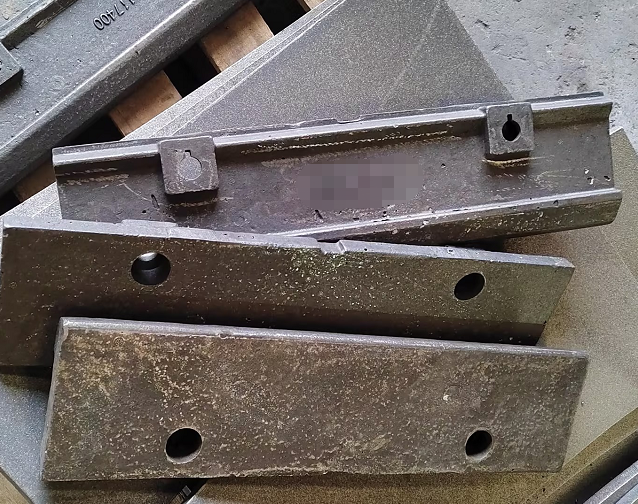
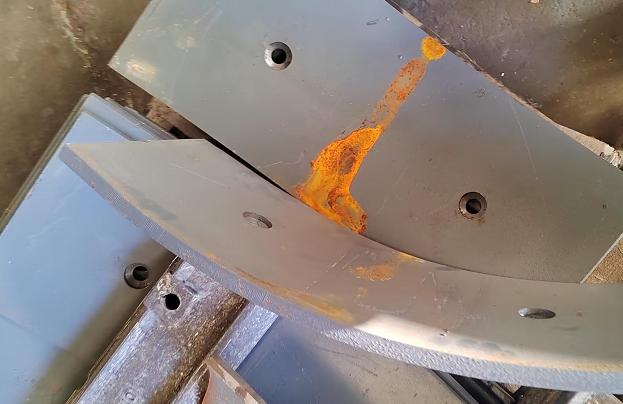
Haitian Heavy Industry Wear Parts:
Hardness: HRC 58–60
Service Life: About 60,000 batches
Wear Behavior:
Uniform wear
Stable structural integrity
Consistent performance throughout service life
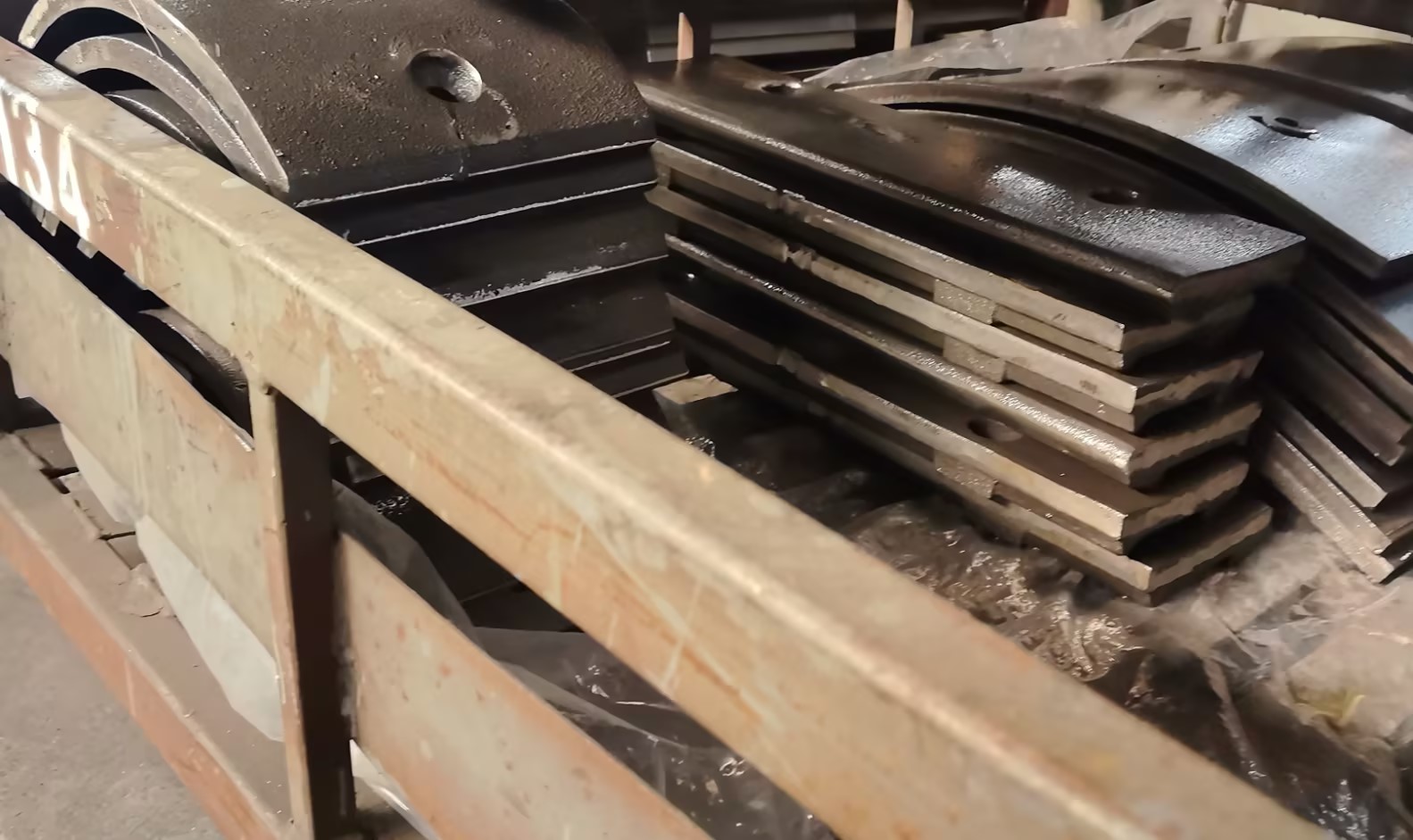
Even with only a 2–4 HRC increase in hardness, and by ensuring dense internal microstructure and smooth surface quality, the service life was doubled, significantly reducing maintenance frequency and cost per batch.
2. Root Cause Analysis: Why Material Composition Determines Wear Performance
Through chemical composition testing, hardness verification, and metallographic analysis of the original wear parts, we identified systematic deficiencies in material design rather than random quality variation.
2.1 Low Chromium Content: A Key Limiting Factor
In wear-resistant cast iron and high-alloy wear-resistant steel, chromium (Cr) is one of the most critical alloying elements, providing:
Formation of high-hardness carbides (such as M₇C₃)
Increased overall hardness and abrasion resistance
Improved stability and distribution of wear-resistant phases
When chromium content is insufficient, the following issues occur:
Inadequate formation of hard carbides
Non-uniform carbide size and distribution
Limited strengthening of the matrix
Testing confirmed that the chromium content of the original supplier’s wear parts was below the recommended range for high-abrasion applications, directly leading to insufficient hardness and accelerated wear.
2.2 Why a Small Increase in Hardness Can Double Service Life
In batching plant operations, wear parts are subjected to:
Abrasive wear from sand and aggregates
Impact loads from coarse aggregates
Cyclic stress during continuous operation
At a hardness level of HRC 56, the surface of the material is more prone to plastic deformation. Aggregates can more easily cut into and plow the metal surface, accelerating material loss.
When hardness is increased to HRC 58–60:
Resistance to plastic deformation improves significantly
Abrasive particles struggle to penetrate the surface
The actual wear rate decreases non-linearly, not proportionally
As a result, in high-abrasion environments, a small increase in hardness beyond a critical threshold can lead to a dramatic extension in service life.
3. Systematic, Condition-Oriented Technical Solution
Rather than pursuing maximum hardness alone, Haitian Heavy Industry developed a comprehensive solution based on the customer’s actual operating conditions, covering material design and full-process manufacturing control.
3.1 Precise Chemical Composition Control
Optimized chromium content to form dense, stable high-hardness carbides
Balanced carbon, chromium, and auxiliary alloy elements to prevent excessive brittleness
Fine-tuned composition according to aggregate type (granite, limestone, basalt, etc.)
3.2 Control of Molten Iron Cleanliness
Strict limits on harmful impurities such as sulfur (S) and phosphorus (P)
Use of refining and inoculation processes to reduce inclusions
Improved matrix density and microstructural uniformity
3.3 Stabilization of Critical Casting Parameters
Pouring temperature control: Preventing coarse microstructures from overheating or defects from underheating
Molding and production line stability: Ensuring dimensional accuracy and internal consistency
In-process quality monitoring: Real-time control to minimize batch-to-batch variation
3.4 Heat Treatment Process Optimization
Customized quenching and tempering processes for wear parts
Achieving higher hardness while maintaining sufficient toughness
Microstructure refinement for consistent and stable wear resistance
4. Preventive Measures: How to Avoid Premature Wear in the Future
From an engineering management perspective, batching plant operators are advised to focus on the following:
4.1 Look Beyond Hardness Values Alone
Hardness by itself does not fully represent wear performance
Chemical composition, microstructure, and heat treatment must be evaluated together
4.2 Choose Suppliers with Application Analysis Capability
Suppliers should tailor material solutions based on aggregate type, mixer speed, drum capacity, and mix design
Avoid “one-material-fits-all” wear parts for diverse operating conditions
4.3 Establish a Quality Traceability System
Each production batch should include composition and hardness records
Critical wear parts should undergo periodic inspection and life tracking
4.4 Evaluate Total Cost of Ownership, Not Unit Price
Longer service life means less downtime and lower labor and maintenance costs
The real savings come from lower cost per batch, not lower purchase price per part
5. Conclusion: Material Composition Is the Foundation of Wear Part Service Life
In the field of batching plant wear parts, material composition is the foundation, process control is the guarantee, and condition matching is the decisive factor.
Even with identical geometry and installation, different material systems and manufacturing controls can result in multiples of difference in service life.
Haitian Heavy Industry remains committed to a condition-oriented engineering approach, combining scientific material design with strict manufacturing control to deliver more wear-resistant, more stable, and more cost-effective wear parts for batching plants worldwide.


 Tik Tok


